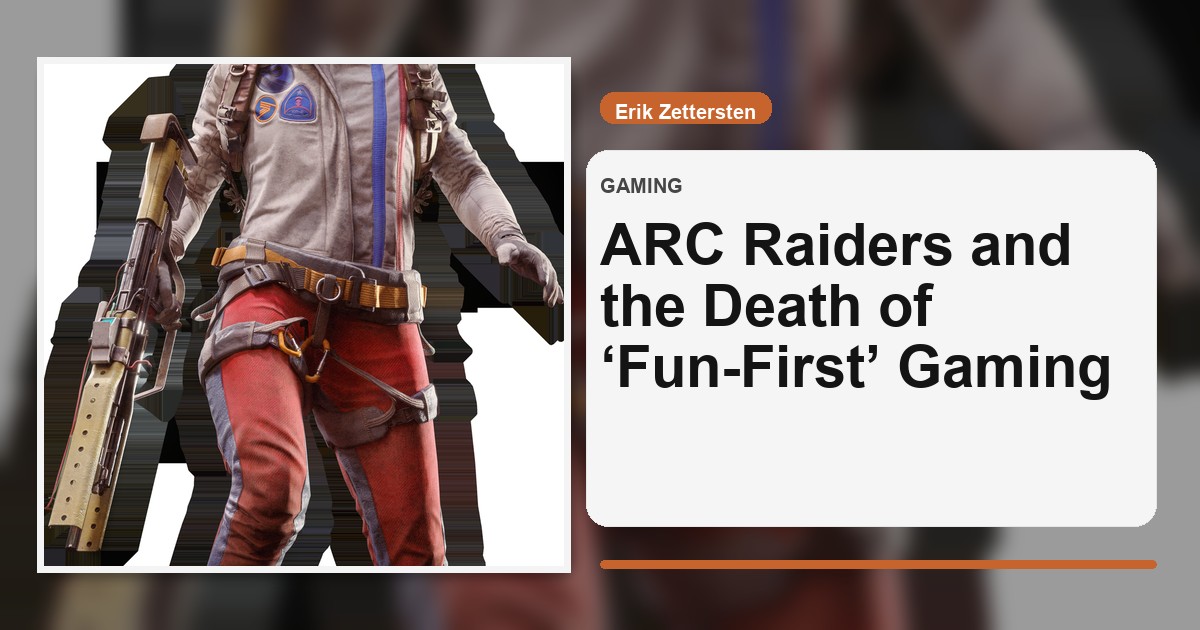
Modern games are better produced than ever.

They are not always more fun.
That disconnect is becoming a pattern: design systems optimized for retention metrics, progression funnels, and monetization loops that slowly flatten emotional payoff.
ARC Raiders sits in that conversation for a reason.
The polish trap
A game can be technically excellent and emotionally thin.
When production quality becomes the primary differentiator, teams often optimize for reliability and scale—but lose the unpredictable spark that creates player obsession.
Fun is hard to dashboard.
So it gets deprioritized.
Analytics as a design governor
Data can improve pacing and balance.
But when every decision is constrained by retention models, design converges toward safe patterns.
Safe patterns rarely become legendary experiences.
Final take
The future of standout games is not anti-data.
It is data-informed, creativity-led design where player emotion is treated as a first-class KPI.
Polish gets players in the door.
Joy keeps them there.
Story map (start → middle → end)
flowchart LR
    A[Start: Thesis + inciting problem] --> B[Middle: Evidence, tradeoffs, failure modes]
    B --> C[End: Opinionated conclusion + specific action]
Concrete example
A practical pattern I use in real projects is to define a failure budget before launch and wire the fallback path in code, not policy docs.
type Decision = {
  confident: boolean;
  reason: string;
  sourceUrls: string[];
};

export function safeRespond(d: Decision) {
  if (!d.confident || d.sourceUrls.length === 0) {
    return {
      action: 'abstain',
      message: 'I don’t have enough reliable evidence. Escalating to human review.',
    };
  }
  return { action: 'answer', message: d.reason, citations: d.sourceUrls };
}
Fact-check context: demand is real, trust is fragile
Gaming demand remains healthy by almost any macro signal. Steam concurrency records keep rising, and the PC ecosystem continues to post strong participation metrics. This is not an audience problem.
But hardware and platform economics are volatile. JPR’s market summaries show a market that can grow overall while still creating pain in specific segments, which is exactly why player sentiment can sour even during headline growth.
In plain terms: people still want to play. They are just less tolerant of pricing games, thin content roadmaps, and strategy-first experiences that forget why players showed up in the first place.