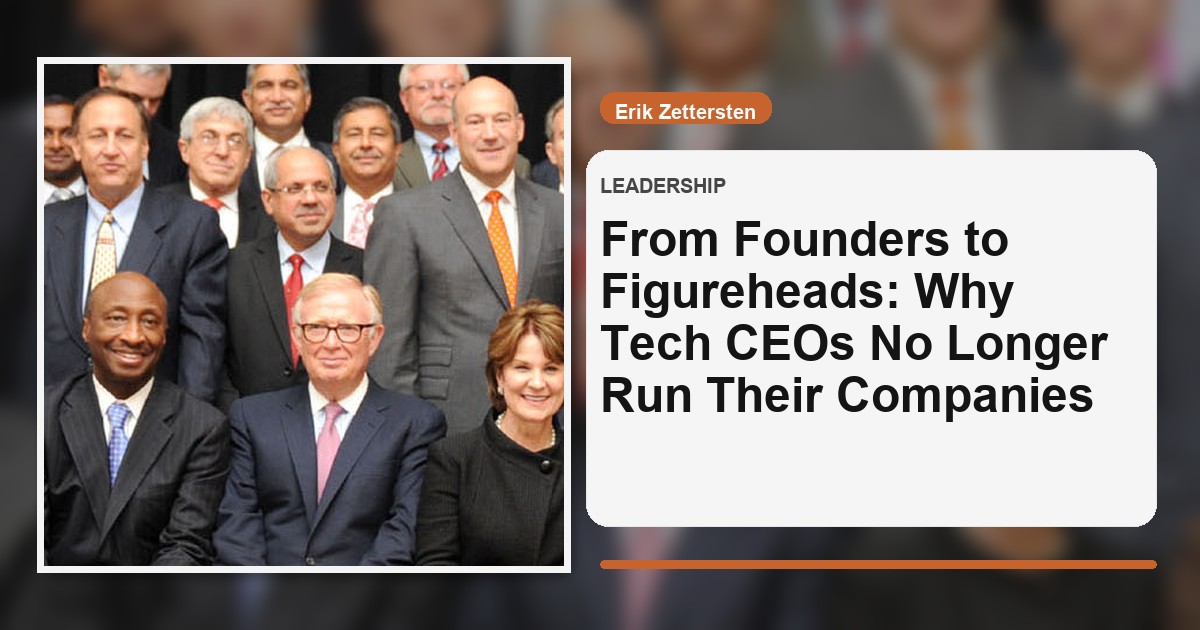
A lot of tech CEOs aren’t really running their companies anymore.
They’re managing the story of the company.
That sounds cynical, but it’s mostly structural. Once a company gets big enough, power fragments:
- boards govern downside risk,
- investors govern expected narrative,
- legal governs language,
- comms governs timing,
- and the CEO governs… tone.
How we got here
Founder-era companies were messy but direct. Product intuition could overrule consensus. Big bets happened because one person was willing to look wrong for a while.
Public-market companies are different. The reward system is quarterly confidence, not long-term conviction. So leadership energy shifts from building to signaling:
- predictable guidance,
- measured phrasing,
- controlled surprises,
- “strategic focus” decks that say very little.
The machine doesn’t want wild insight. It wants volatility management.
What breaks when leadership becomes narrative-first
You can feel it inside the org:
- product choices optimize for optics,
- mid-term investments get cut because they look expensive in the next two calls,
- teams stop believing the stated strategy,
- smart operators leave because real tradeoffs are made elsewhere.
This is how companies become internally performative: everyone sounds aligned, nobody feels aligned.
What real CEO leadership still looks like
The best CEOs I’ve seen still “build,” even if they never touch code:
- they own hard tradeoffs instead of delegating blame,
- they protect uncomfortable truths from being polished away,
- they keep incentives tied to outcomes, not messaging.
Spokespeople protect reputation.
Leaders protect reality.
Those are not the same job.
Story map (start → middle → end)
flowchart LR
    A[Start: Thesis + inciting problem] --> B[Middle: Evidence, tradeoffs, failure modes]
    B --> C[End: Opinionated conclusion + specific action]
Concrete example
A practical pattern I use in real projects is to define a failure budget before launch and wire the fallback path in code, not policy docs.
type Decision = {
  confident: boolean;
  reason: string;
  sourceUrls: string[];
};

export function safeRespond(d: Decision) {
  if (!d.confident || d.sourceUrls.length === 0) {
    return {
      action: 'abstain',
      message: 'I don’t have enough reliable evidence. Escalating to human review.',
    };
  }
  return { action: 'answer', message: d.reason, citations: d.sourceUrls };
}
Fact-check context: leaders are behind their teams
Microsoft’s Work Trend data keeps showing the same pattern: employees are adopting AI tools faster than leadership operating models are catching up. In practice, that means shadow workflows, inconsistent quality bars, and policy drift hidden behind productivity gains.
GitHub Octoverse reinforces the velocity story: AI-related project activity and contributions continue to rise quickly, which means the technical surface area inside teams keeps expanding. More output is not the same as better outcomes.
So the management job has changed. The scarce skill is no longer “unlock output.” The scarce skill is building a system where output remains trustworthy under pressure.