Most AI discourse is still trapped in a single question:
“How smart is the model?”
Taalas is forcing a different one:
“How fast, cheap, and deployable is the model for real workloads?”
That shift matters.
Their framing in The path to ubiquitous AI is blunt: latency and cost are the true blockers to AI becoming ambient infrastructure. Not benchmarks. Not demos. Not vibes.
And honestly, they’re right.
Start: the controversial truth people don’t want to say out loud
A lot of teams are overfitting product strategy to frontier-model aesthetics.
You see polished demos, long tool chains, and giant orchestration stacks built to compensate for slow inference. Then everyone acts surprised when unit economics collapse.
Taalas is making the opposite bet:
- specialize hard,
- move from simulation to embodiment,
- make model inference feel closer to a utility primitive than a research event.
Their phrase “The model is The Computer” is dramatic branding, but the strategic point is real: if inference drops toward sub-millisecond and near-zero marginal cost, architecture priorities flip.
What they actually announced (and why it matters)
From their own launch details:
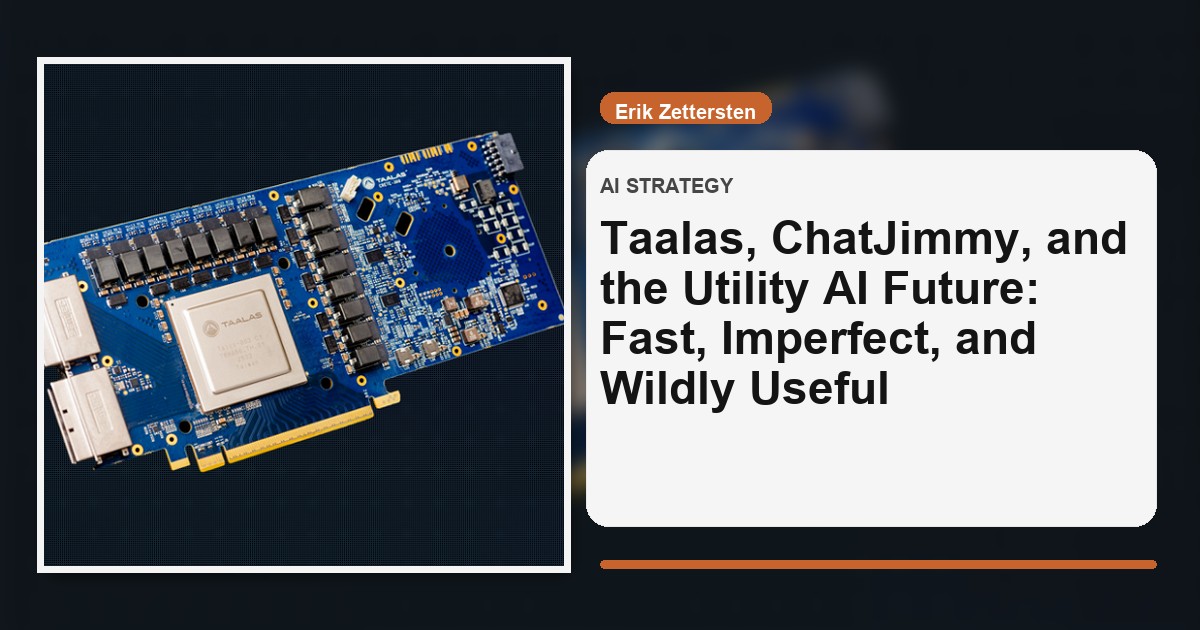
- hard-wired Llama 3.1 8B on custom silicon,
- public-facing demo via ChatJimmy,
- API access path,
- claimed speed/cost/power gains versus software-first baselines.
They also openly acknowledge tradeoffs: aggressive quantization in gen-1 silicon introduces quality degradation relative to GPU baselines.
That transparency is refreshing.
Most companies hide this part under glossy language.
Taalas effectively says: yes, first-gen quality is imperfect in places, and yes, this is still worth shipping because latency/cost unlock new classes of applications.
That is a serious operator mindset.
Middle: where this fits in the real stack
Here’s my take in plain terms:
The current model may be a little shotty compared to top-end models in open-ended reasoning.
But this is not a Sonnet/Opus replacement story.
This is a utility inference story.
Think of tasks like:
- “take this blob of text and map it into this strict JSON schema,”
- parse semi-structured responses into UI artifacts,
- normalize noisy text payloads into deterministic event shapes,
- classify lightweight edge cases with very low ambiguity.
For this category, ultra-fast specialized inference can beat regex-heavy glue code and brittle custom parsers in both development speed and operational simplicity.
You don’t need a philosopher model for these jobs.
You need a reliable transform primitive that is:
- fast enough to sit in the hot path,
- cheap enough to run everywhere,
- consistent enough for downstream systems.
That’s the opening.
The strategic inversion nobody is planning for
If Taalas (or anyone else in this lane) is directionally right, we’re about to invert where bottlenecks live.
Today, teams treat model calls as expensive and scaffolding as cheap.
Tomorrow, the model call could become the cheapest part of the transaction—and everything around it becomes the tax:
- tool invocation overhead,
- API round trips,
- orchestration graph complexity,
- observability fan-out,
- policy middleware layers,
- retries and circuit-breaker choreography.
When inference becomes nanosecond-fast relative to the surrounding system, your orchestration stack can become the slowest and most expensive component by default.
That is a weird sentence in 2026.
It may also be where this industry is heading.
Where I’m bullish
I’m bullish on specialized utility models for:
Structured transformation pipelines
- text → schema,
- schema A → schema B,
- extraction + normalization under strict output contracts.
Latency-sensitive UX layers
- adaptive UI state shaping,
- real-time assistive micro-interactions,
- interface artifacts generated on demand without user-perceived lag.
Cost-sensitive high-volume workloads
- support preprocessing,
- log/event enrichment,
- document normalization at scale.
If this can run with lower power and simpler infra, it matters for edge deployments and for any org tired of “AI feature” meaning “new GPU bill.”
Where I’m skeptical
I’m skeptical on two fronts:
- General reasoning expectations: users and product teams will over-attribute capabilities if the latency feels magical.
- Benchmark storytelling: it’s easy to cherry-pick throughput narratives while underplaying quality cliffs in edge cases.
In short: don’t confuse speed with intelligence.
Treat this like a new compute primitive with specific strengths, not a universal model upgrade.
Practical adoption rubric (for teams evaluating this now)
If you’re evaluating Taalas-style infrastructure, ask:
- Which workloads are truly transform-heavy and low-reasoning?
- What output schemas can be strictly validated post-inference?
- Where does orchestration overhead dominate p95 latency?
- Which flows break if model quality dips slightly?
- What fallback path exists for abstention or low confidence?
- What is the total cost per successful transformed artifact?
If you can’t answer these, you’re not evaluating a platform.
You’re chasing novelty.
End: my opinionated conclusion
Taalas is not interesting because it “beats everyone” on generalized intelligence.
Taalas is interesting because it challenges the hidden assumption that AI must stay expensive, slow, and infra-heavy to be useful.
That assumption has quietly distorted product design for two years.
I think the right framing is:
- not model-vs-model,
- not hype-vs-hype,
- but utility-grade inference for concrete jobs.
If you need deep reasoning and world modeling, use frontier systems.
If you need fast, cheap, structured transformation in production workflows, this approach could be a genuine unlock.
And if the industry keeps reducing latency by orders of magnitude, the winning teams won’t be the ones with the fanciest prompt stack.
They’ll be the ones who redesigned their systems around a new truth:
when inference gets cheap enough, architecture discipline becomes the differentiator.