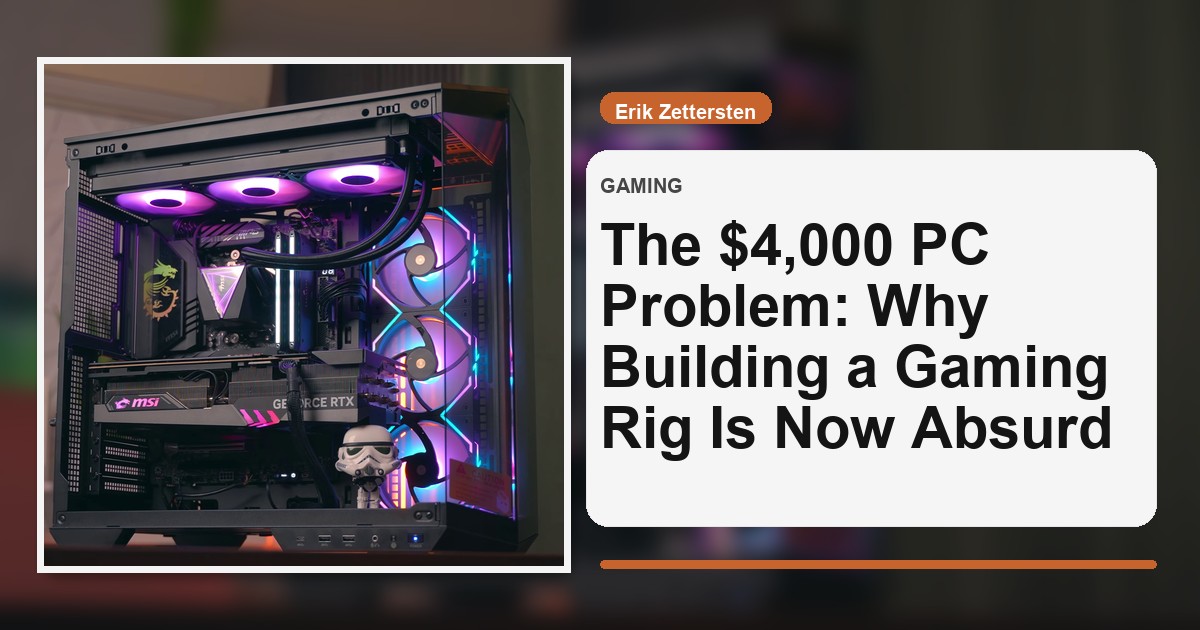
Building a high-end gaming PC used to feel clever.
You’d hunt deals, pick smart parts, and end up with something powerful that beat prebuilt pricing and console limitations.
Now? A lot of “enthusiast” builds feel like you accidentally wandered into luxury retail.

When a mainstream build approaches $4,000, we should stop pretending this is normal market evolution. It’s a broken value equation.
How the price stack got out of control
No single company caused this. It’s a pileup:
- flagship GPU pricing became the anchor for everything below it,
- generational gains got less exciting while price jumps got bolder,
- premium RAM/SSD branding turned basic components into lifestyle purchases,
- software features and ecosystems nudged buyers toward lock-in,
- launch scarcity trained people to panic-buy.
Each piece is explainable. Together, they produce a market where “pretty good” costs what “top-tier” used to cost.
The loyalty tax nobody wants to admit
Enthusiast communities are passionate, and that passion gets monetized.
If your identity is tied to one brand, you become less price-sensitive. Companies know this. Marketing knows this. Shareholders definitely know this.
That’s the loyalty tax: paying premium prices not because the performance delta is transformative, but because the brand signal feels important.
A sane buyer strategy in an irrational cycle
If you still want to build, you can avoid the worst traps:
- Buy off frame-time and workload data, not reveal-day vibes.
- Skip first-wave launches unless you genuinely need day-one performance.
- Balance the build instead of maxing one component for social-media bragging rights.
- Track total platform cost (power, cooling, monitors, accessories), not just the GPU invoice.
Final take
Hardware companies aren’t villains. They’re doing what profit-seeking companies do.
But buyers need to stop behaving like unpaid brand advocates.
If pricing drifts this far from practical value, discipline beats fandom every time.
Story map (start → middle → end)
flowchart LR
    A[Start: Thesis + inciting problem] --> B[Middle: Evidence, tradeoffs, failure modes]
    B --> C[End: Opinionated conclusion + specific action]
Concrete example
A practical pattern I use in real projects is to define a failure budget before launch and wire the fallback path in code, not policy docs.
type Decision = {
  confident: boolean;
  reason: string;
  sourceUrls: string[];
};

export function safeRespond(d: Decision) {
  if (!d.confident || d.sourceUrls.length === 0) {
    return {
      action: 'abstain',
      message: 'I don’t have enough reliable evidence. Escalating to human review.',
    };
  }
  return { action: 'answer', message: d.reason, citations: d.sourceUrls };
}
Fact-check context: demand is real, trust is fragile
Gaming demand remains healthy by almost any macro signal. Steam concurrency records keep rising, and the PC ecosystem continues to post strong participation metrics. This is not an audience problem.
But hardware and platform economics are volatile. JPR’s market summaries show a market that can grow overall while still creating pain in specific segments, which is exactly why player sentiment can sour even during headline growth.
In plain terms: people still want to play. They are just less tolerant of pricing games, thin content roadmaps, and strategy-first experiences that forget why players showed up in the first place.